A compact castle visit that fits easily into a wider Harlech day.
CHECK FIRST · OPENING
Harlech keeps seasonal Cadw hours — as late as 6pm in summer, as early as 4pm close in winter — with last admission 30 minutes before closing, and it’s closed on 24–26 December and 1 January. Check current Cadw opening hours before you set off.
Time needed
1–2 hours for the castle and wall-walks
Best time
Longest hours Jul–Aug · clear days for the Snowdonia backdrop
Opening, entry & booking
From £10.90 adult (summer) · book online for a discount
Access & difficulty
Flat approach and bridge · steep, uneven tower stairs: no lift
Parking & start point
Small paid car park at the entrance · town parks are a steep walk up
Getting there
Harlech station ~200m · bus stop ~150m (G23)
Toilets, food & facilities
At the visitor centre · baby change
Dogs
On leads at all times · ground floor only
Plan with confidence.Detailed information on arrival, access, facilities, restrictions and local conditions.
Opening, entry & booking
1 Mar–30 Jun
9:30am–5pm
1 Jul–31 Aug
9:30am–6pm
1 Sep–31 Oct
9:30am–5pm
1 Nov–28 Feb
10am–4pm
Last admission
30 minutes before closing.
Closed
24, 25 and 26 December and 1 January.
Tickets
Adult £10.90, Senior £9.80, Junior/Student £7.60 (2026 summer rate). A £1 Cadw ticket is available for Universal Credit recipients. Buy on arrival, or book online for 5% off: online bookings are non-refundable. Booking is not required. Disabled visitors and one companion go free.
On site
An exhibition, gift shop and guidebooks in the visitor centre.
Opening hours and prices are set by Cadw and change through the year.
A small car park with accessible spaces sits right at the visitor centre entrance. Larger car parks exist lower down in the town, but Cadw’s own access guide warns these involve a very steep walk up to the castle.
Harlech station, about 200m away, on the Cambrian Coast line.
Bus
A stop about 150m away, on Lloyds Coaches’ service G23: the Barmouth–Harlech–Porthmadog coast service. Check the current service before travelling.
Cycling
On National Cycle Network Route 8.
Public transport & car-free access
By rail
Harlech station is on the Cambrian Coast line and sits below the castle: one of the few Welsh castles you can genuinely arrive at by train. Times and tickets from Transport for Wales.
The catch
The station is below the rock; the castle is above it. Expect a steep climb up through the town from the platform.
By bus
Lloyds Coaches’ service G23 runs the A496 coast between Barmouth and Porthmadog, calling at Harlech. Check the current service before travelling.
Toilets, food & facilities
Toilets
At the visitor centre, with baby-changing facilities.
Café
Caffi Castell operates on site, using local suppliers.
Shop
Gift shop and guidebooks in the visitor centre; water refill point, free WiFi, and EV charging (2 × Type 2, 22kW, charges apply).
Accessibility & terrain
Cadw rates the interior “Level 3 — Moderate.” The route from the visitor centre onto the footbridge is flat and evenly paved with a gentle upward slope, but the towers and wall-walks are reached only by steep, narrow, uneven historic stairs.
Terrain
Level 3: Moderate.
Approach
Flat and evenly paved from the car park to the visitor centre and footbridge.
Lift
None: towers and wall-walks are stair-only.
Hearing
Portable induction loop available.
Visitor centre
Wide automatic doors, low admissions desks, accessible exhibition space and café.
Dogs & restrictions
Dogs must be kept on leads at all times. Non-assistance dogs are permitted on the ground floor only.
Safety, weather & local conditions
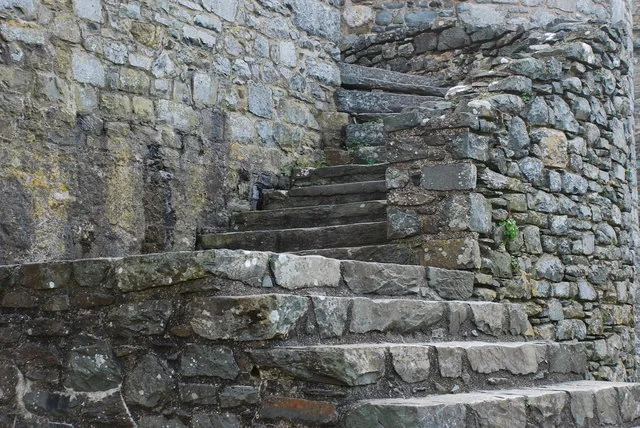
Normal awareness for a historic monument with towers and steps. Take care on the steep, uneven historic stairs and wall walks, especially with children, and note that the upper towers have no step-free alternative.
PLACE-SPECIFIC DETAILS
Other place details
Heritage status
UNESCO World Heritage Site since 1986
Café
Caffi Castell on site, using local suppliers
What to bring
Comfortable shoes
A layer for the towers
Card for parking & tickets
Water
Camera
Castell Harlech
Not a ruin on flat ground. A fortress on a crag.
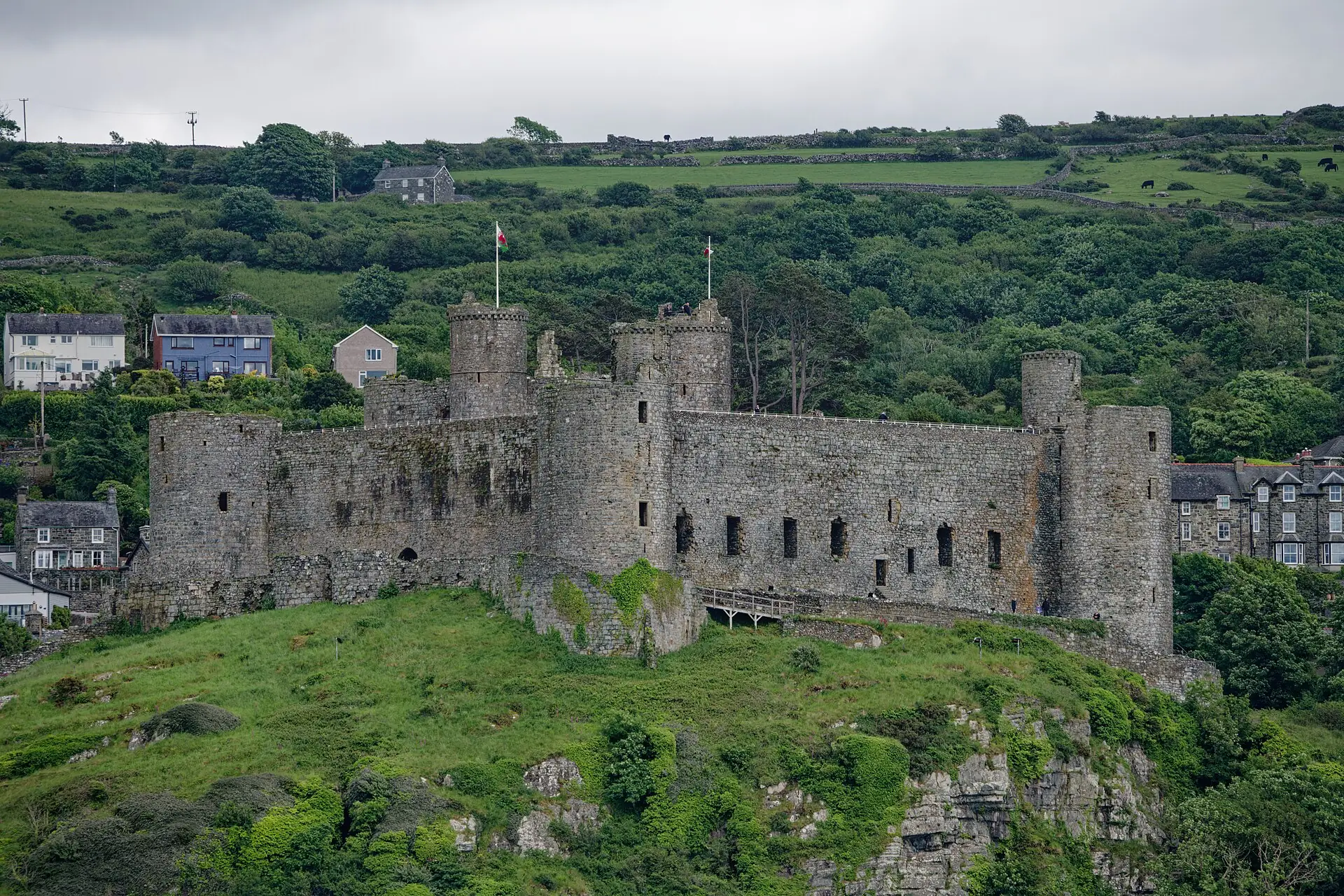
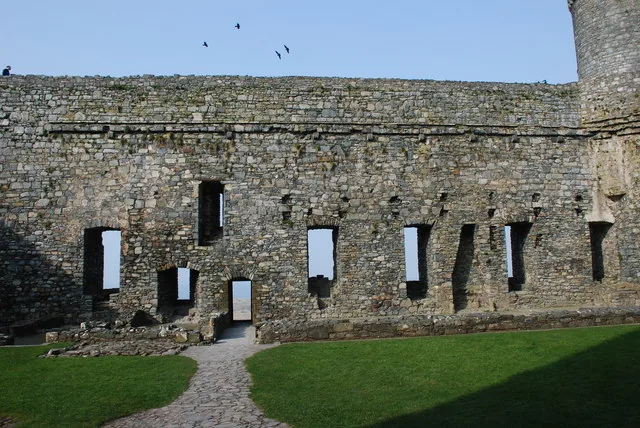
Built between 1282 and 1289 by Edward I, Harlech is one of the four great castles — with Beaumaris, Caernarfon and Conwy — that make up the “Castles and Town Walls of King Edward in Gwynedd” World Heritage Site. Cadw itself calls its setting, crowning a sheer rocky crag above the dunes, probably the most spectacular of any of Edward’s Gwynedd castles.
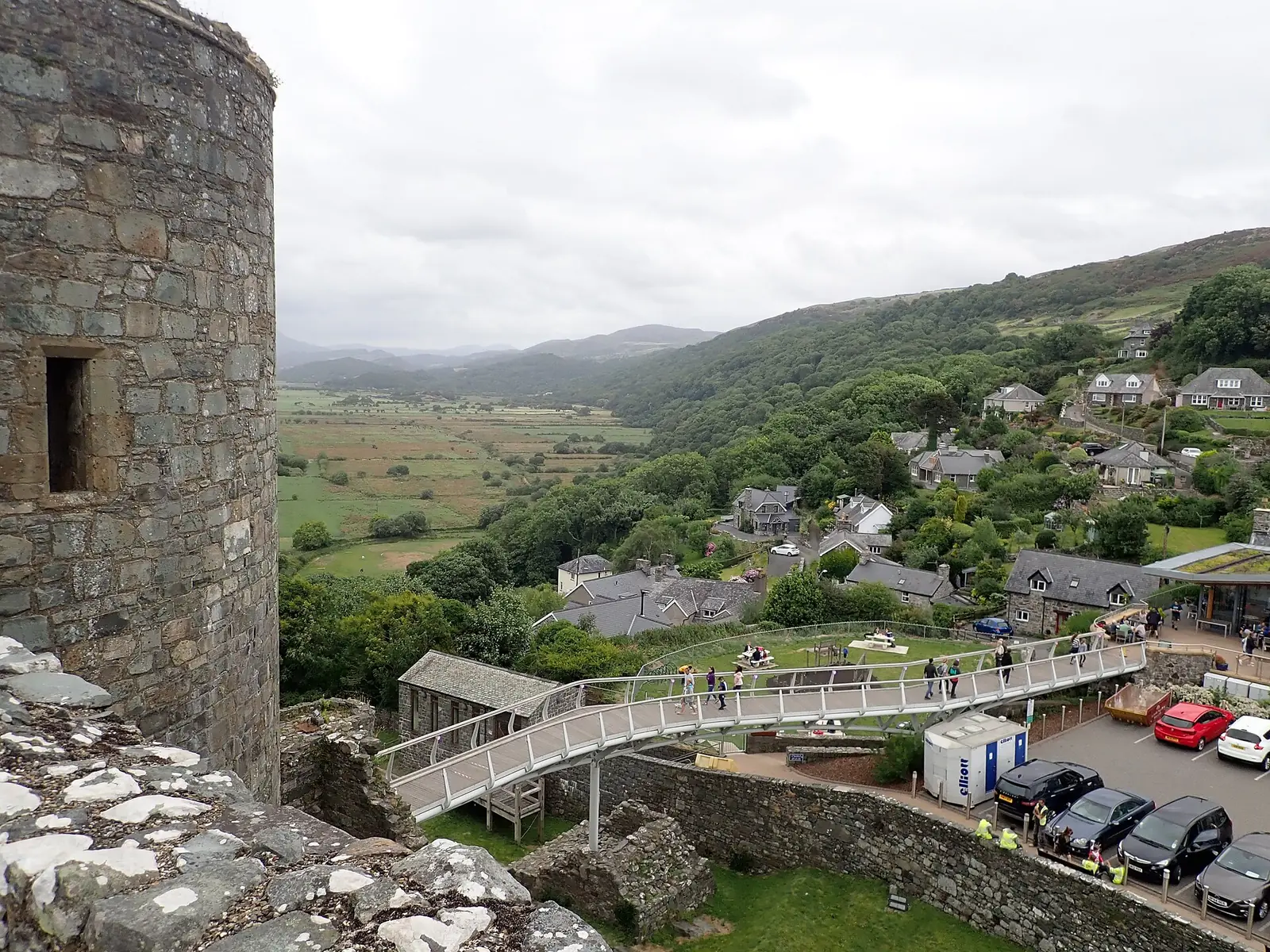
A modern footbridge now carries you in much as Master James intended: for the first time in six hundred years.
A crag, and a bridge across to it.
Should this shape your day?
A UNESCO World Heritage castle you can genuinely climb through: the approach is easy, the towers are not.
Good fit for
history & architecture visitors
families and walkers who can manage stairs
anyone touring the Meirionnydd coast or Eryri
royal-history and Welsh-history interest
Think twice if
you need step-free access to the towers
you have very limited stamina for stairs
you’re visiting with a non-assistance dog and want full access
you’re arriving late in the day: Cadw hours are seasonal, closing as early as 4pm in winter
Allow a proper hour or more, and cross the footbridge slowly: it recreates the castle’s original approach.
Weathered stone, still standing on its crag.
One crag, seven scenes.
A suggested order. See the shape of the visit before you commit to it.
01 Visitor centre
A flat, level approach: shop, exhibition, café.
02 The footbridge
A modern crossing built to Master James’s intent.
03 The gatehouse
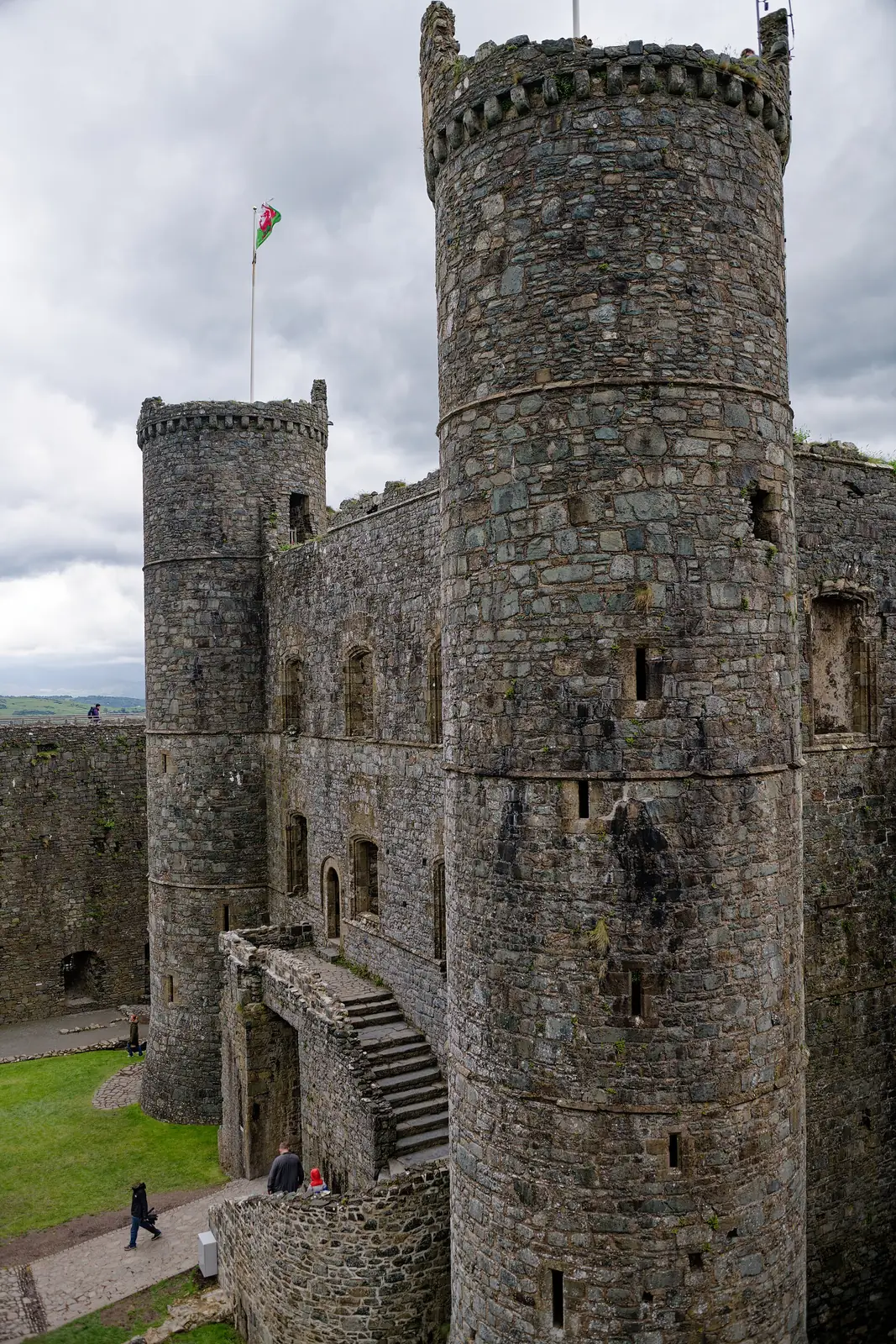
Twin drum towers, the main threshold.
04 The wards
Inner and outer, concentric and open.
05 The towers
Steep, uneven stairs: no lift, no shortcut.
06 The wall-walk
Views over the dunes, and inland to Eryri.
07 Way from the Sea
108 rock-cut steps that once supplied the castle.
Seen along the way.
Towers, stone and the crag: the castle before you cross the bridge.
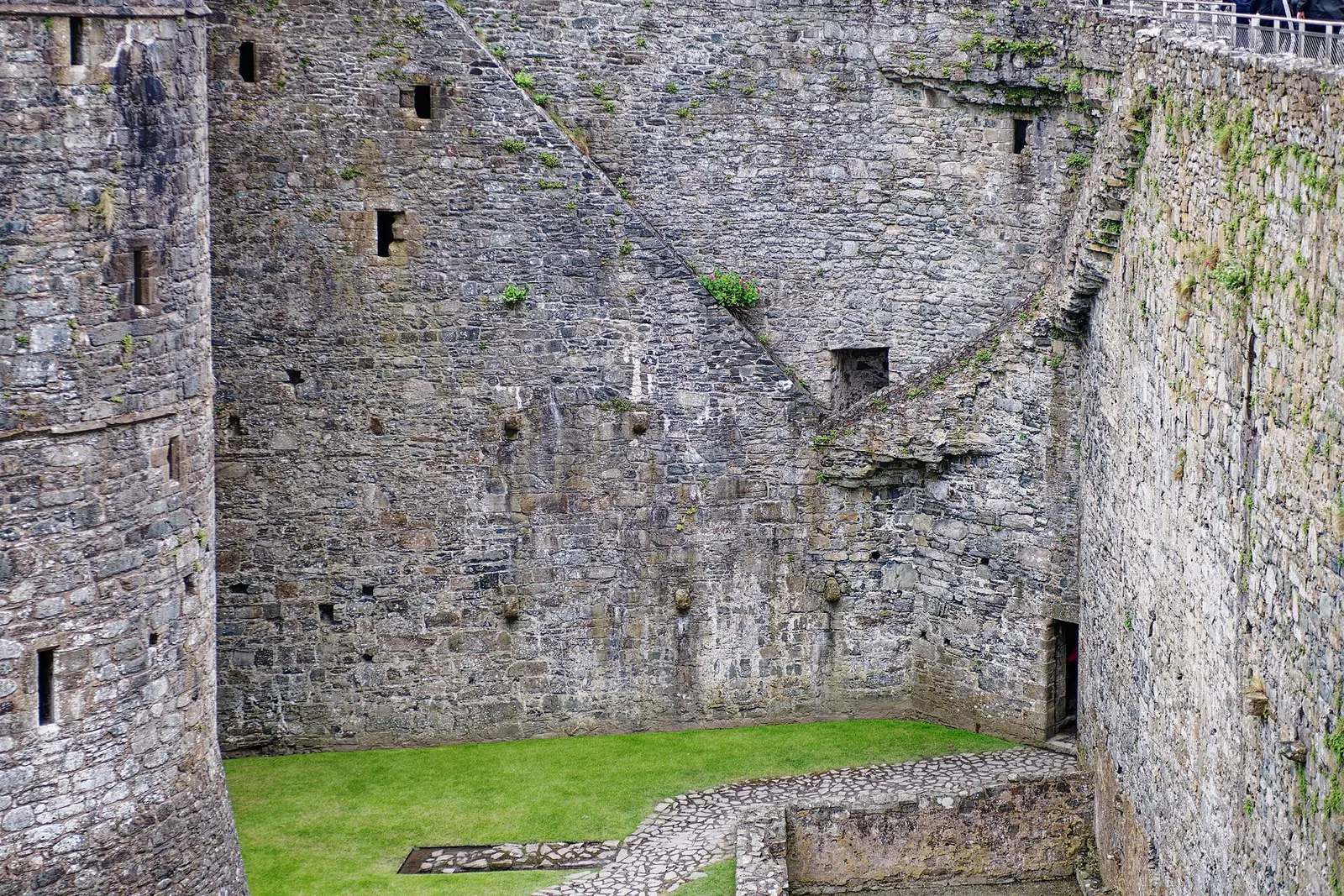
The gatehouse towers: seen close from the wall-walkThe footbridge: the way in, as it was meant to beThe stairs: steep, narrow, and the only way upThe ward: open ground within the wallsStone on the crag: six centuries of weather
What stays with you
The parts people remember
A compact fortress on a crag, entered the way it was meant to be.
01
Level ground, castle above
The approach from the visitor centre stays flat while the castle does not: it sits above on bare rock, seen from below for the whole walk in.
02
Across the bridge
A pale modern walkway crosses the gap and delivers you between the twin drum towers of the gatehouse, at the height the entrance was built for.
03
Concentric and contained
Inside, the wards sit one within the other. The plan is tight and readable in a way that larger castles are not: outer wall, inner wall, and the gatehouse holding both.
04
Steps cut into the rock
Off the west wall a stair drops away down the crag face, worn treads running toward ground that the water once reached.
05
Dunes one way, mountains the other
From the wall-walk the land divides cleanly: flat dunes and sea to the west, Eryri stacked inland. Then the bridge takes you back out.
The rock does half the work, and you feel it on the way in.
From the Harlech archive
A conquest, a court, a song, and a surrender.
Four field notes on this castle’s record: construction, Welsh rule, siege, and the Civil War. One entry carries a famous tradition, and it is labelled as one.
Most of this is documented history. One entry is a well-known tradition, and it is labelled as one.
Field notes
Four entries. Open one to read the note.
Construction Fact
1282: a castle on a crag begins
Field note I · filed under construction
Edward I’s master builder raised a fortress on the site’s natural defence — a sheer rock crag — in just seven years.
What is known
Construction ran 1282–1289 under Edward I, with Master James of St George directing the project. Cadw states the castle was “completed from ground to battlements in just seven years.”
The design
A concentric layout: four round corner towers on the high inner ward, a lower outer ward as a secondary line of defence, and a twin-drum-towered gatehouse.
What to notice there
The “Way from the Sea” — 108 rock-cut steps — once let the castle be resupplied by sea when the shoreline reached much closer to the crag than today’s dunes.
Welsh rule Fact
1404: a Welsh court, not an English one
Field note II · filed under Glyndŵr
For five years, this Edwardian fortress belonged to Wales, not England.
What is known
In 1404 the castle fell to Owain Glyndŵr, who used it as his residence and military headquarters, and as a seat of his parliament, until English forces — traditionally associated with the future Henry V — recaptured it in 1409.
Before Glyndŵr
The castle had already withstood the 1294–95 Madog ap Llywelyn revolt intact, unlike some of Edward I’s other Gwynedd castles.
What to notice there
Five years is a short span against seven centuries of history, but it is the span in which this English-built fortress became, briefly, a genuine seat of Welsh government.
Siege & song Tradition
1461–1468: the siege behind a song
Field note III · filed under the Wars of the Roses
One of Wales’s most famous songs is traditionally tied to a long, documented siege of this exact castle.
What is known
During the Wars of the Roses, Harlech was held by Lancastrian forces through a long siege, surrendering to Yorkist forces on 14 August 1468.
What tradition says
The song “Men of Harlech” is traditionally associated with this siege and the garrison’s long resistance: a well-known cultural connection, though the song’s own documented origin isn’t independently confirmed here.Tradition, not proven origin
What to notice there
Whatever the song’s exact origin, the siege itself — and the castle that endured it — is real, documented history.
Civil War Fact
1647: the last to fall
Field note IV · filed under the Civil War
Three and a half centuries after it was built, Harlech was still worth defending: longer than any other mainland fortress.
What is known
During the Civil War (1642–1647), Harlech became the last mainland fortress to hold out for the Crown, surrendering to Parliamentarian forces on 15 March 1647.
Since then
The castle passed into ruin and is now managed by Cadw as a scheduled monument and Grade I listed building, open to visitors year-round.
What to notice there
By 1647 the castle had already stood through revolt, Welsh rule, and a famous siege: this was its fourth and final defence.
Don’t let the day end at one pin.
Four stops that turn Harlech into a wider Gwynedd day.
About 3.5 miles north
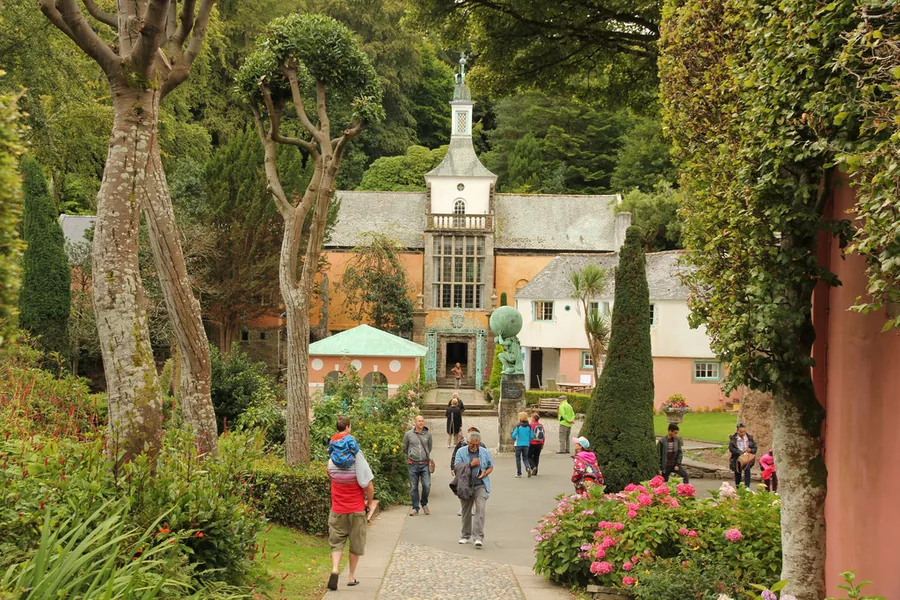
Portmeirion
Clough Williams-Ellis’s Italianate village on the Dwyryd estuary, built over fifty years.